總網頁瀏覽量

顯示具有 EM 標籤的文章。 顯示所有文章

氣喘噴劑 列表

氣喘噴劑 列表

● SABA
    Ventolin inhaler 100 mcg/d, 200d
      (salbutamol) 1 puff tidprn

● CS/ LABA
    Foster inh. 100/6 mcg/d, 120d
      (beclomethasone, formoterol) rapid onset and long duration
    Seretide 125 evohaler 125/25 mcg,
      (fluticasone propionate, salmeterol)
    Seretide 250 evohaler 250/25 mcg,
      (fluticasone propionate, salmeterol)
    Symbicort * turbuhaler 120 dose 160/4.5 mcg
      (budesonide, formoterol)

● LAMA/ LABA:
    Berodual MDI 200 puff 20/50 mcg, 200 puff
      (ipratropium, fenoterol)

● LAMA
    Spiriva inh. 2.5 mcg/puff, 60 puff
      (tiotropium) 1puff qd

Equivalent doses:
   Beclomethasone 400 mcg  =  Fluticasone 200 mcg  =
   Mometasone 200/400 mcg  =  Budesonide 400 mcg  =
   Ciclesonide 160 mcg  =  Clenil 400 mcg  =  Qvar 200 mcg.

Binding affinity, reference Dexamethasone 100;
   Budesonide 935;   Ciclesonide 1200;
   Beclomethasone 1345;   Fluticasone propionate 1775;
   Mometasone 2100;   Fluticasone furoate 2980.


.

急診短講002 ─ 特殊急救術之高血鉀

急診短講002 ─ 特殊急救術之高血鉀

高血鉀成因

●攝入增加:低鈉鹽、高鉀食物(實例:5條香蕉、半斤莧菜、黑棗汁)
●排除減少:急性腎損傷、藥物(保鉀利尿劑、ACEi/ARB、NSAIDs、乙型阻斷劑)
●產量增加:腫瘤溶解症候群、橫紋肌溶解、(醫源性)溶血

高血鉀治療
●穩定心臟膜電位
○○IV CaCl2 (vitacal, 2% 20mL) 1-2amp
  【配套:12-lead ECG, serum free Ca, 接上 ECG monitor】
  【若 ECG 波形有變化,最先使用;否則使用順位往後延】

●將鉀往細胞內移動
○○IV D50W(20mL) 3amp + RI 10U
  【配套:依 serum glucose 調整 D50W 及 RI 劑量!】
○○IV bicarbonate(7% 20mL) 3amp
  【配套:依 blood gas bicarbonate 及 base excess 調整】
○○IH ventolin (5mg) 2amp
  【心跳快勿用;使用順位較後面】

●將鉀排出體外
○○從腎排除:lasix (20mg) 1-2amp
  【低血壓勿用;用於仍能排尿(非洗腎)病人】
○○從腸排除:kalimate 2WP (+lactulose 20mL)
  【避免嗆到,必要時放 NG;可加 lactulose 避免便秘】
○○從血洗出:血液透析
  【治療效果不彰時使用,如腎功能極差、寡尿、鉀降不下來】

...

快郎中學堂 第三

學堂 第三:專題課程

1. Video Procedure Database
    Emergency Medicine Residents' Association 上的實用學習影片
    有些影片是 NEJM 的,需於院內 IP 連網閱讀。

2. A Starter's Roadmap to EM Resources:
        Books, Websites, and Apps
    Academic Life in Emergency Medicine (ALiEM)
        給新進急診住院醫師的學習地圖

3. Integration of Social Media in EM Residency Curriculum
    Ann of Emerg Med 提供的雲端學習資源 (2014)

4. Resources and Tutorials on EM Ultrasound
    超音波教學示範網站

另有

學堂 第一:每月核心課程
學堂 第二:年度核心課程
可供參考學習!

...

FQ 療效比較

FQ (fluoroquinolone) 這麼多種,療效都差不多嗎?

常見的 FQ 有三種:
  cipro (ciprofloxacin),
  levo (levofloxacin),
  moxi (moxifloxacin)
基本的藥物特性如下表:


一般而言,
cipro 對 gram neg 有效,就三種 FQ 比較而言,cipro 對 P. aeruginosa 療效較好 (強調一下:就三種 FQ 比較而言,下同)。
levo 對 gram pos, gram neg 都不錯,atypical 也罩得住,深受眾人愛戴使用。
moxi 對 gram pos, gram neg 都不錯,anaerobe 也罩得住。特別是 gram pos 的 strep pneuomniae 及 staph aureus,故軟組織感染有其一定的角色!

學理上如此,也要看看當地的藥物敏感性/抗藥性如何!
例如:以 gram neg 為例,根據下述資料判斷(104上半年):

一般培養常見 GNB 前四名依次為~ 
E. coli, P. aeruginosa, K. pneumoniae, A. baumannii

血液培養常見 GNB 前四名種類一樣,排序稍有變動,依次為~ 
E. coli, K. pneumoniae, A. baumannii, P. aeruginosa


注意一下 E. coli,cipro 和 levo 似乎不給力;
就連 P. aeruginosa,cipro 是比 levo 好一些 (血中感受性較好),
 但也不是很理想,在嚴重感染關鍵時刻時得深思~
K. penumoniae,cipro 和 levo 差不多肉腳,
 血中感受性還可以接受。


...

快郎中學堂 第二

有別於個人體會之作的『私塾』,
快郎中學堂』乃為培育國家級快郎中的集體智慧平台,
歡迎"準"快郎中們登堂入室...

快郎中前傳
學堂 第一:每月核心課程

學堂 第二:年度核心課程

  C00 期末(103)筆試考題解析 (鄭緯、邱柏齊、雷文相總醫師年度巨獻)
    期末(104)筆試考題解析 (感謝 張家瑜張家銘賴俊誠 無私貢獻)
    年度(105)筆試考題解析 (感謝 林佳霖 洪荒之力作)
  C01-1 急診執業模式與專業能力里程碑 (急診醫學會、徐德福醫師輯錄)
  C01-2 標準化直接觀察評估工具 (徐德福醫師提供)
  C01-3 住院醫師政策暨 Case & Skill Log登錄 (徐德福醫師提供)

  C02 急診病歷、診斷書、同意書書寫原則 (陳春廷醫師提供)
  C03 緊急醫療救護系統介紹(含醫療指導)
  C04 化災規劃與病患處理原則(含HICS)
  C05 核災規劃與病患處理原則

  S01 超音波實務操作 (1) 腹部、骨盆腔 (張家瑜醫師提供)
  S02 超音波實務操作 (2) 胸部、心臟血管、其他部位 (張家瑜醫師提供)
  S03 實證醫學 (1) 綜論文獻搜尋 (徐德福醫師提供)
  S04 實證醫學 (2) 研究設計及文獻評論
  S05 進階呼吸道處置(含內視鏡、Pentax 操作)

學堂 第三:專題課程

...

急性中風之CT影像

Head CT Reading Mnemonic  - Blood Can Be Very Bad
頭部電腦斷層讀片口訣 - 見血可是非常糟!

Blood

  • Locations of the major blood supply to the brain, Circle of Willis in the suprasellar cistern
  • Acute blood is bright white on CT
  • EDH (lens-shaped), SDH (sickle-shaped), Intraparenchymal (esp. basal ganglia, deep bleed vs. cortical bleed), intraventricular (watch for hydrocephalus), SAH (Blood in cisterns)
  • Acute sequelae: EDH - lateral or transtentorial herniation.

Can: 4 key Cisterns 

  • Quadrigeminal (W-shaped), circummesencephalic (ring around midbrain), suprasellar (star-shaped, circle of Willis), sylvian (between temporal and frontal lobes)
  • Blood in cisterns (SAH, aneurysmal rupture), effacement of cisterns (IICP)

Be: Brain parenchyma (adjust contrast window)

  • Symmetry, shift, gray-white differentiation, hyper/hypodensity, sucal patterns, basal ganglia location, pneumocephalus. 
  • Limitations of posterior-fossa imaging.
  • Early ischemic stroke: loss of gray-white differentiation, asymmetry of gyral pattern, insular ribbon sign
  • Trauma -contusion; Nontrauma- tumor, abscess, or atrophy
  • Contrast effect on BBB destruction.

Very: Ventricles 

  • CSF produced in lateral ventricles (back-to-back commas)  Third ventricle (slit-shaped)  aqueduct of Sylvius → Fourth ventricle (Helmet-haped). Approximatedly 20ml/h
  • Look for effacement (hydrocephalus), ventricular shift, and blood.
  • Acute hydrocephalus: transependymal flow
  • Brain Atrophy

Bad: Bony skull (use bone window)

  • Note soft tissue swelling, basilar skull fracture, and sinus pathology.
  • Look for blood/air-fluids level in sinuses/mastoid air cells, and widened sutures.

...


急性中風之當代影像

Contemporary Imaging for Acute Stroke (ref 1)
ref: http://www.medscape.org/viewarticle/761327

一、急性梗塞性中風

Computed Tomography (CT)

  Unenhanced CT: 打 rt-PA 唯一官方認證影像。
    從幾近正常 (near normal)
    到微小變化 (subtle change)
      loss of insular ribbon
      loss of gray-white differentiation
      sulcal effacement
    到明顯的低密度變化 (frank hypodensity)

  Enhanced CT: perfusion study
    成像縮寫與全文,見附註(1)
    灌流顯像 perfusion study
      CTA-SI: hypodensity,梗塞周邊因為有 pial collaterals (亮區),
        所以會襯托出 hypoperfusion 的區域。
      因為注射顯影劑的技術及 delay 取像的設定,hypodensity
        的範圍有時會比 DWI 多 20% - 35%。
      CBV map (CT perfusion) 範圍會先大於 MTT map。
      CBV 會先升後降,並不是一個很好的 infarct core 估計指標!

Magnetic Resonance Imaging (MRI)

  MRI 成像縮寫與全文見附註(2);腦血流 MRI 影像變化見附註(3)

  一般原則:
  T1-weighted imaging (T1WI) 口訣 "肥肥白白"
    fat >> hyperintensity; water >> hypointensity
  T2-weighted imaging (T2WI) 口訣 "水水亮亮"
    water >> hyperintensity; fat >> hypointensity

  DWI (b=1000, MRI) hyperintensity (意指 diffusion restriction)
    範圍約略等於 CBV map (CT perfusion);
    DWI 可視為胞毒性水腫
    近期梗塞 (1-2週內) 為高訊號。
  MTT (MRI perfusion) hyperintensity 範圍大於 DWI (MRI),
    多出的範圍可視為 "ischemic penumbra",
    若血管阻塞的位置比 circle of Willis 還近心端(顱外血管阻塞),
    會造成 prolongation in MTT 而 false positive (本來病人可能
    沒有 infarct 或 ischemic penumbra 沒那麼大)!
  ADC (restrictive diffusion on the apparent diffusion coefficient):
    hypointensity
  rCBV (relative cerebral blood volume, PWI MRI) map:
    低訊號 = 低血流。
  FLAIR (fluid-attenuated inversion recovery, MRI): 看不出來 或
    非特異性高訊號
  T2WI (MRI): 急性梗塞看不出來 或 有非特異性高訊號;
    陳舊梗塞 (~12週) 為高訊號
    若中央有低訊號,為梗塞後出血遺跡 (hemosiderin)。

  結論:MTT map (MRI) > DWI area (MRI),
  Ischemic penumbra 面積 > 超過 20% DWI area,
  打 rt-PA 才有意義。
  另一說法:DWI volume < 70 mL,可以打 rt-PA,而不需做 PWI。

二、腦實質出血

  CT 沒甚麼好說的,太容易看了。

  T2WI (MRI): 早期出血中心會亮亮的,周邊有一圈 low-intensity
    border,此為血塊/正常腦組織介面上形成 deoxyhemoglobin,
    為 actively metabolizing brain 所致,稱之為 deoxyhemoglobin
    border sign
  GRE  (gradient-recalled echo, MRI):
    low-intensity border (deoxyhemoglobin),
    hyperacute hemorrhage (oxyhemoglobin) inside the border
    is isodense  to the white matter
  EPI (echo planar image from DWI): hypointensity or
    complete black

三、蜘蛛膜下腔出血

  T2 FLAIR (MRI): 正常是黑的 CSF,變成亮的 CSF
    血腫為黑的 (deoxyhemoglobin)

附註:

(1) CT 成像縮寫與全文
  CT angiography (CTA): CTA source images (CTA-SI)
  CT perfusion (CTP): mean-transit-time (MTT) or
    time-to-peak (TTP) maps, cerebral blood volume (CBV) map,
    cerebral blood flow (CBF) map = CBV / MTT

(2) MRI 成像縮寫與全文
  Unenhanced sequence: T1WI (spin echo, SE),
    T2WI (fast spin echo, FSE),
    EPI DWI (echo planar image diffusion-weighted image)
  Enhanced sequence: MR angiography (MRA),
    perfusion-weighted imaging (PWI)
    包括: mean-transit-time (MTT) or
    time-to-peak (TTP) maps, cerebral blood volume (CBV) map,
    cerebral blood flow (CBF) map = CBV / MTT

(3) 腦血流 MRI 影像變化
  Normal of an elderly brain: CBF = 50 mL/100g brain/min
  Symptoms of stroke: CBF = 17 - 20 mL/100g brain/min
    (33% of normal): PWI maybe (+)
  Cytotoxic edema (胞毒性水腫): CBF = 10 mL/100g brain/min
    (20% of normal): DWI (+)
  Vasogenic edema (血管性水腫): CBF < 10 mL/100g brain/min
    超過 1 小時。

  當 CBF < 17 mL/100g brain/min (reversible ischemia),
    腦功能開始喪失,但是腦結構仍 OK。
  當 CBF 介於 10 - 17 mL/100g brain/min 之間,就是所謂的
    "ischemic penumbra",為核心梗塞向外延伸的高危險區域!
  當 CBF < 10 mL/100g brain/min 超過一段時間
    (irreversible infarct),blood-brain barrier 破壞,
    形成 vasogenic edema (血管性水腫)

  說明:CBF = CBV / MTT
    當 CBF 減少時 (中風),初期 CBV 會代償性增加;若持續 CBF 減少,
    CBV 會隨之減少,因為側枝循環的結果,後期會造成血流的 MTT 增加
    (血流較晚流進中風組織,故 time 增加)

Other reference: Brain Ischemia - Vascular territories:
http://www.radiologyassistant.nl/en/p484b8328cb6b2/brain-ischemia-vascular-territories.html


...

快郎中學堂 第一

有別於個人體會之作的『私塾』,
快郎中學堂』乃為培育國家級快郎中的集體智慧平台,
歡迎"準"快郎中們登堂入室...

快郎中前傳:
『急診醫學模式』(EM Model 中文版) 好比是急診專科的立「科」憲法,其中隱含急診所需的核心能力,也是急診專科訓練與考試的核心文件。而『里程碑計劃』 (Milestones 中文版),是將醫學知識、技能、態度以及其他醫師所需的核心能力,組織成一個從基本到進階的發展架構。所附連結為急診醫學會正在發展中的釋出版本,是不可不讀的寶典!

學堂 第一:每月核心課程
另有最新未公開資料於 e-learning 公佈,請善加利用!

  G01 急診實戰手冊 (陳春廷醫師修訂,邱苓瑜醫師原著)
    交班教學檔、急診工作手冊,事涉病人隱私,請向 CR 索取紙本講義。
  G02 急診病歷寫作 (陳春廷醫師提供)

  M01 緊急醫療救護體系之基本概念與演變
  M02 大量傷患與檢傷分類 (侯重光主任提供)
  M03 內科急症急救五要素 (徐德福醫師提供)
    M04 意識改變之評估與處置
    M05 發燒及感染急症之評估與處置
    M06 呼吸窘迫之評估與處置
  M07 胸痛講座
  M08 急性腹痛之評估與處置 (侯重光主任提供)
  M09 急診常見中毒之評估與處置
  M10 實證急診 (徐德福醫師提供)
  M11 急重症模擬安妮演練

  S01 急診創傷一般原則 (I)、(II)、(III)、(IV)
  S02 傷口評估與處置
  S03 創傷評估ABCDE
  S04 外傷呼吸道處理
  S05 胸腹部外傷之評估與處理
  S06 腹部創傷
  S07 外傷 OSCE 討論
  S08 家暴/性侵議題

學堂 第二:年度核心課程

學堂 第三:專題課程

...

口訣集注

Mnemonic Collections

Altered Mental Status – AEIOU TIPS
  • A – Alcohol
  • E – Endocrine, Electrolytes, Encephalopathy
  • I – Insulin (high or low BS)
  • O – Oxygenation, Overdose (Opiates, hypnOtics)
  • U – Uremia
  • T – Trauma
  • I – Infection
  • P – Poisoning, Psychiatric
  • S – Stroke (infarct or hemorrhage), Seizure, Shock

Acute Abdomen  BIOPI
  • B – Bleeding or hemorrhage: AAA, HCC or spleen rupture/ peptic ulcer bleeding
  • I – Ischemia or infarct: ischemia bowel/ renal infarct
  • O – Obstruction: intestinal obstruction/ biliary or ureteral stone obstruction
  • P – Perforation: perforated peptic ulcer/ hollow organ perforation
  • I – Infection or inflammation: hepatobiliary tract infection, appendicitis, diverticulitis, pancreatitis

Focus Fever Survey in the ED LOUIS
  • L – Lung infections: URI related history taking and PE
  • O – others
  • U – Urinary tract infections: UTI, APN
  • I – Intra-abdominal infections or abscess: hepatobiliary, appendicitis, diverticulitis, colitis...
  • S – Soft tissue infections: decubitus ulcers or bedsores, cellulitis, fasciitis

Brain CT Reading Mnemonic – Blood Can Be Very Bad
  • B – Blood
  • C – 4 key Cisterns
  • B – Brain Parenchyma
  • V – Ventricles
  • B – Bony Skulls

另有 High Anion Gap Metabolic Acidosis (連結)

    ...

    2012 Surviving Sepsis Campaign 指引

    2012 年 Surviving Sepsis Campaign 臨床指引出爐了,
    針對嚴重敗血症及敗血性休克的治療,第一線醫師該注意些甚麼?

    PS: 美國急診醫學會官方期刊,在2013年9月刊登了一篇給急診醫師看的文章,
    題為 Surviving Sepsis Campaign Guidelines 2012: Update for Emergency Physicians. (PMID: 24067755),可以參考看看。

    臨床指引依循 GRADE (Grading of Recommendations Assessment, Development and Evaluation) 模式,證據等級從 A (high) 到 D (very low) 四類,建議等級有 1 (strong) 或 2 (weak) 兩種。有些建議未分級,標示為 UG (ungraded)。GRADE 1C 的治療,表示依據 weak evidence (C),強烈建議 (1) 使用此建議治療。

    主要十大建議如下:(針對第一線醫師或急診醫師)

    1. 在辨識有嚴重敗血症的 6 小時內,盡快達成 eraly goal-directed therapy (EGDT) 的量性指標 (1C)。  

    2. 使用抗生素前抽多套 blood cultures (1C)。

    3. 在辨識有敗血性休克 (1B) 或沒有休克的嚴重敗血症 (1C) 的病患,在 1 小時內盡快使用廣效型抗生素。需每日評估病患,以降階使用適當的抗生素 (1B)。

    4. 急救輸液首選晶質溶液 (crystalloid) (1B),針對需大量晶質溶液才能維持足夠平均動脈壓者,可以考慮使用加用白蛋白 (albumin) (2C),避免使用 hetastarch (一種膠質溶液) (1C)。初始輸液量至少需要 30 mL/kg 的晶質溶液,有些病患甚至需要更大量的輸液 (1C)。

    5. Norepinephrine 為首選的升壓劑 (1B),維持平均動脈壓 (MBP) >= 65 mmHg。可以加 epinephrine 為輔助升壓劑 (2B)。除非情況特殊 (例如:有症狀的緩脈),否則不建議例行使用 dopamine (2C)。dobutamine 單獨使用,或和升壓劑一起使用於下列兩種狀況:高的心臟填充壓 (cardiac filling) 或低的心臟輸出 (cardiac output)、已足夠輸液及達足夠的平均動脈壓仍有持續性的低灌流徵象 (signs of hypoperfusion) (1C)。

    6. 如果輸液及使用升壓劑可以穩定血流動力,則避免使用靜脈注射 hydrocortisone (2C)。

    7. 在沒有組織灌流不足、心臟缺氧、急性出血的情況之下,血色素的標的為 7-9 g/dL (1B)。

    8. 連續兩次血糖值高於 180 mg/dL,需使用胰島素治療,治療目標為 <= 180 mg/dL (1A)。

    9. 有胃出血危險因子者,需使用預防性的壓力性潰瘍治療 (1B)。

    10. 診斷敗血症的前 48 小時內,只要病患可以忍受,盡快使用經腸道進食,而不要完全禁食 (2C)。

    其他指引細節,請參考原版全文 http://www.ncbi.nlm.nih.gov/pubmed/23353941


    ...

    EBM 期刊討論 (3) - 顱內出血需使用抗癲癇藥嗎?


    顱內出血病患需預防性使用抗癲癇藥嗎?

    臨床情境:
    57歲男性,因頭痛合併左側肢體無力至急診求診。頭部電腦斷層顯示右側丘腦(thalamus)出血,估計出血量4mL。會診神經外科後,建議控制血壓,及使用預防性抗癲癇藥物。你的疑問:腦內出血病患都需要使用預防性抗癲癇藥物嗎?
    (血壓控制請參考:急性中風血壓控制)

    聚焦的臨床問題:
    P: intracerebral hemorrhage OR intracranial hemorrhage
    I: anti-epileptic drugs, levetiracetam (keppra, 神經外科醫師建議用藥)
    C: placebo control
    O: mortality, convulsion rate, adverse effect
    D: systematic review, randomized controlled trials
    Q: therapy/prevention type

    使用資料庫:
    UpToDate, National Guideline Clearinghouse, Medline (PubMed)

    UpToDate:
    Search terms: adult intracerebral hemorrhage
    挑選條目:Spontaneous intracerebral hemorrhage: Prognosis and treatment
    Last updated 六月27, 2012

    Seizure prophylaxis and treatment:
    ... If a seizure occurs, appropriate intravenous antiepileptic drug (AED) treatment should be administered to prevent recurrent seizures. (發生癲癇,當然需要使用抗癲癇用藥,和我的病人情況不一樣)
    ... While some experts suggest a brief period of AED prophylaxis soon after ICH onset as a potential means of reducing the risk for early seizures in patients with lobar hemorrhages. (2007 AHA/ASA指引:專家意見指出,大葉腦出血病患,使用抗癲癇藥物,為降低早期癲癇風險的可行方式)
    ... 2010 guidelines recommend against prophylactic use of AEDs. (2010 AHA/ASA指引:不建議預防性使用抗癲癇藥物)

    哇哇...那到底需不需要用AED(抗癲癇藥物)?

    既然UpToDate引用的兩個指引意見相左,所以就來找找原始Guideline到底怎麼寫...

    Google搜尋National Guideline Clearinghouse
    Search term: intracerebral hemorrhage

    挑選條目:(第一條)
    Guidelines for the management of spontaneous intracerebral hemorrhage in adults. 2007 update: a guideline from the American Heart Association/American Stroke Association Stroke Council, High Blood Pressure Research Council, and the Quality of Care and Outcomes in Research Interdisciplinary Working Group. 2007 Jun. NGC:005680

    在Recommendations for Initial Medical Therapy段落

    Class I
    2. Appropriate antiepileptic therapy should always be used for treatment of clinical seizures in patients with ICH (Class I, Level of Evidence B).
    發生癲癇,需要使用抗癲癇用藥,建議等級Class I,證據等級B,意思是:證據等級中等 (來自單篇隨機或非隨機對照研究的結果),治療效果一致且顯著。

    Class II
    5. A brief period of prophylactic antiepileptic therapy soon after ICH onset may reduce the risk of early seizures in patients with lobar hemorrhage (Class IIb, Level of Evidence C).
    腦內出血時,短期間使用預防性抗癲癇藥物也許可以降低早期癲癇的發作,建議等級Class IIb,證據等級C,意思是:證據等級低 (來自專家意見的結果),治療效果較不一致或不顯著。

    在guideline最後的NGC Status說明此guideline歷經Mar 2008, Dec 2008, May 2009, July 2010的更新。其中抗癲癇治療在2010有更新。

    加上建議等級及證據等級之後,似乎明瞭不少!

    使用PubMed搜尋一下吧。
    前面資料庫及guideline所使用的最新文獻只到2010年,所以使用PubMed的重點,就是2010以後的高品質文獻!
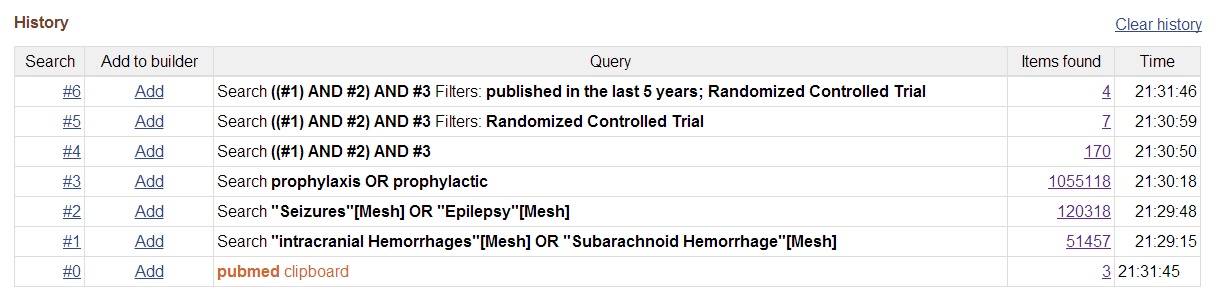
    搜尋結果如下,


    找到主題相符的三篇文章,結果如下,


    小評讀一下:

    #1. Are post intracerebral hemorrhage seizures prevented by anti-epileptic treatment? Epilepsy Res. 2011 Aug;95(3):227-31. PMID: 21632213.

    P: non-traumatic, non-aneurysmatic spontaneous intracerebral hemorrhage (SICH) 自發性腦出血
    I/C: valproic acid (VPA) or placebo (Pbo) immediately after a SICH for 1 month
    O: occurrence of seizures, neurologic outcome (NIHSS) @ 1 year
    D: prospective randomized, double-blind, placebo-controlled clinical trial

    N =72, VPA =36, Pbo =36
    癲癇總發生率21%,兩組間發生率無顯著差異,但VPA可減少早期癲癇。
    VPA可以改善NIHSS分數。
    缺點:病例數太少。

    #2. Prospective, randomized, single-blinded comparative trial of intravenous levetiracetam versus phenytoin for seizure prophylaxis. Neurocrit Care. 2010 Apr;12(2):165-72. PMID: 19898966.

    P: severe traumatic brain injury (sTBI) or subarachnoid hemorrhage 外傷性腦出血
    I/C: iv levetiracetam (LEV) vs. iv phenytoin (PHT) 2:1 ratios
    O: seizure occurrence (diagnosed by cEEG), Disability Rating Scale score @ 3 months, Glasgow Outcomes Scale score @ 6 months, mortality, side effects
    D: prospective, single-center, randomized, single-blinded comparative trial

    N =52 (89% sTBI), LEV =34, PHT =18
    LEV vs PHT
    早期癲癇: 14.7% vs 16.7% 無顯著差異
    6個月癲癇: 5% vs 0% 無顯著差異 (咦...)
    長期預後較好 (DRS score, GOS score)
    死亡率: 41% vs 22% 無顯著差異 (哇......)
    腸胃副作用較高。
    缺點:病例數更少,和我的病人不符,死亡率有偏高傾向!

    #3. Prophylactic antiepileptic drug use is associated with poor outcome following ICH. Neurocrit Care. 2009;11(1):38-44. PMID: 19319701.

    P: patients within 6 h of the onset of acute ICH (placebo arm of Cerebral Hemorrhage and NXY-059 Trial)
    I/C: early prophylactic antiepileptic drugs (AEDs)
    O: poor modified Rankin Scale of 5 or 6 (severely disabled or dead) @ 90 day
    D: international multicenter randomized trial >> clinical trial cohort

    N =295, 腦出血量中位數14.9 (IQR 7.9-32.7); 平均數23.3 (SD 22.8) ml
    癲癇發生率1.7%,第90天嚴重預後(mRS 5 or 6) 28%
    早期預防抗癲癇藥物使用於8%的病人,這群病人嚴重預後風險較高 (OR 6.8; 95% CI: 2.2-21.2)
    缺點:非隨機對照,僅為控制組世代的病例對照研究,易有選擇性偏差。

    那到底要不要使用預防性抗癲癇藥物?
    1. 發生癲癇就需治療。
    2. 專家建議 (神外),畢竟病患是他們照顧。
    3. 證據說話:要看病患族群(自發性vs外傷性出血),癲癇發生率(地區流病調查),選用藥物來看。
    第一篇癲癇預防無啥效,但長期預後好。第二篇是外傷病患,不符所需。第三篇使用藥物反而預後差。

    眾說紛紜何時了? 大家看著辦吧!


    ...

    EBM 期刊討論 (2) - HES 對嚴重敗血症有效嗎?


    臨床情境:
    75歲男性,中風臥床,在安養中心因高燒及量不到血壓而送至急診,經初步評估及檢查,臆斷為敗血症休克,可能為泌尿道感染,或吸入性肺炎。因血壓不穩,這時你尋思該用何種輸液以進行急救? 該用晶質溶液 (crystalloid) 或是膠質溶液 (colloid) ?

    聚焦的臨床問題:
    P: septic shock or severe sepsis
    I: colloid, hydroxyethyl starch
    C: crystalloid, ringer’s lactate
    O: mortality, renal outcome, coagulation profile
    D: systematic review, randomized controlled trials
    Q: therapy type

    使用資料庫:
    UpToDate, Medline (PubMed)

    UpToDate:
    Search terms: adult sepsis
    Last updated 七月12, 2012

    Summary and Recommendations:
    ... There are no data to support preferential administration of crystalloid or colloid (See 'intravenous fluids' above.) 未有足夠證據支持使用晶質溶液或膠質溶液較好

    Intravenous fluids:
    ... We do not use hydroxyethyl starch or pentastarch. (cited major references: NEJM 2004, 2012, and 2008) 蝦咪,不建議使用HES

    PubMed:
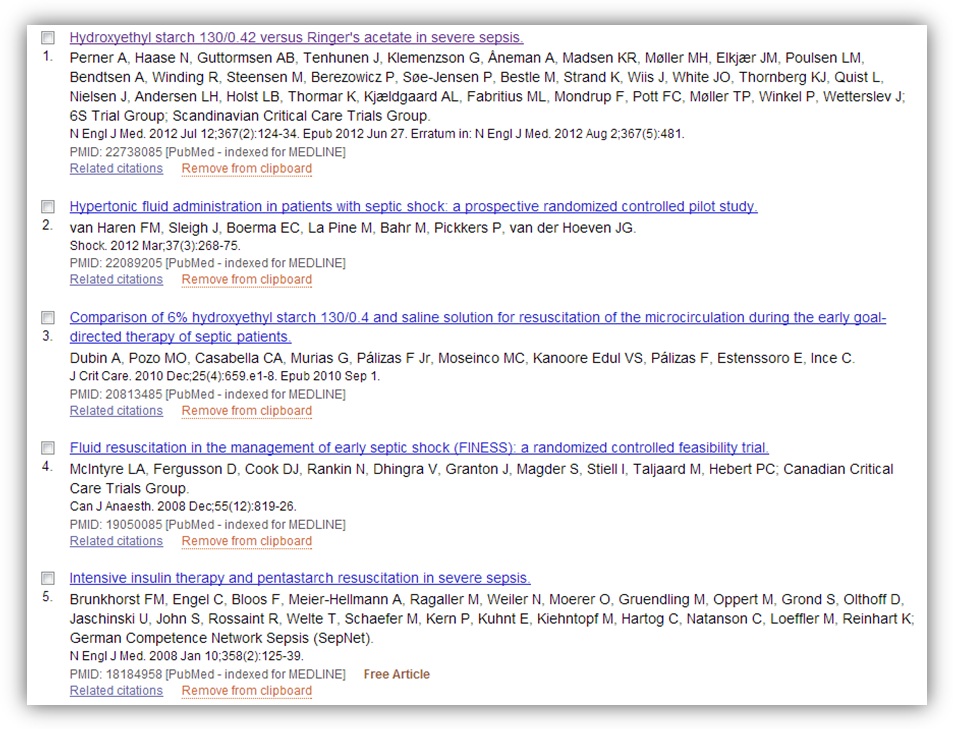
    Search results as below (advanced)


    挑選主題相符的meta-analysis OR systematic review文章:1 & 2


    也有找到麻吉的randomized controlled trials文獻:1&5 (就是UpToDateNEJM 2012, 2008那兩篇,英雄所見略同嘛)


    找到這麼多的參考資料,該如何挑選呢?

    先看看有實證精神的資料庫 (在此指UpToDate) 如何寫,其中有談到2004, 2012, 2008的三篇 NEJM文章。

    或是直接看最新的metaSR的文章,也有2011 Ann Surg2010 Crit Care的兩篇。

    再來是上述metaSR出品後 (2010),年代更新的RCT,那就是熱騰騰的2012 NEJM了!

    評讀:

    摘錄Ann Surg. 2011 Mar; 253(3): 470-83.Table 4


    標黃線的是2008 NEJM那篇的摘錄使用HES 200/0.5ringer's lactate比較,使用> 22 mL/kg/dayHES,其死亡的OR3.08倍,95% 信賴區間1.78-5.37

    節錄Crit Care. 2010; 14(5): R191.Figure 3, 4.
    pool四篇文獻的結果,使用HEScontrol
    acute kidney injuryOR1.92倍,95% 信賴區間1.31-2.81
    mortalityOR1.41倍,95% 信賴區間1.01-1.96 (險險沒跨過1,有顯著差異)

    至於剛出爐的N Engl J Med. 2012 Jul 12;367(2):124-34. 這邊就留待讀者自行細細體會。結論:對於嚴重敗血症的病患("P"atient population),接受HES 130/0.42輸液復甦 ("I"ntervention),相對於ringer's acetate ("C"ontrol),有顯著較高的死亡風險及接受洗腎率("O"utcome),有傾向(但統計上不顯著地)增高急性腎損傷及嚴重出血的發生率。

    不能免俗地算一算NNH

    90天的死亡風險
      HES vs. ringer's acetate: 50.5% vs. 43.0%
      Absolute Risk Increase = 7.5%
      Number Needed to Harm = 1/ARI = 14

    洗腎率 (短期)
      HES vs. ringer's acetate: 21.9% vs. 16.3%
      Absolute Risk Increase = 5.6%
      Number Needed to Harm = 1/ARI = 18

    所以囉,HES該不該用,該用多少 (至少不能用大量),該得好好思量一下。聽說Surviving Sepsis Campaign快要改版了,讓我們拭目以待。

    ...

    急性中風之血壓控制


    配方建議:
    Nicardipine (perdipine): 10 mg/10 mL/amp
    滴注 2-5 mg/hr,每 5-15 分鐘調整 2 mg/hr (10 mL/hr) 直至治療目標,最大量 15 mg/hr
    配法:5 amp in NS 200 ml, total 250 mL, 開始劑量 10-15 mL/hr, 最大量 75 mL/hr。
    注意:建議使用 NS 做為調劑輸液,除非病人有發生低血糖風險
    注意:高齡病患考慮以較低劑量開始,以較緩和的調整為輔。

    Labetalol (trandate): 25 mg/5 mL/amp
    12.5 mg IVD 5 min,若未達治療目標,每 10 分鐘可用 25 mg 給予 IVD 10 min,總劑量不要超過300 mg (12 amp)。
    滴注 2-8 mg/min,每 10 分鐘調整直至治療目標,總劑量不要超過 300 mg。
    配法:12 amp = 60 mL, 開始劑量 24 mL/hr (總劑量有300 mg!)
    注意:若病人心跳太慢,不可使用 labetalol!

    另有降血壓神藥 nitroglycerin,多用於心因性高血壓急症 (ACS/HF),另文詳述。 

    ...

    Give Me N = 5 腎梗塞

    Renal Infarct 之 Give Me Five

    2012 年 9 月 Am J Emerg Med 刊登了一篇
    由以色列的 Meir Antopolsky 等人發表的回顧性文章 (收錄年:1999-2009),
    題為"腎臟梗塞的十年急診經驗及文獻回顧"

    在繁忙的急診時空內,要快速診斷腎臟梗塞,需有過人的警覺及經驗,簡單地說,如果符合下列五項指標,就得高度懷疑:(姑且稱之為 Renal Infarct 之 Give Me Five)

    Flank Pain, Nausea/Vomiting, elevated LDH, Hematuria, Af


    其中 flank pain (93%) 不稀奇,血管都塞死了,哪有不痛的道理,倒是 LDH 升高,竟也有 95% 之譜,實在值得注意!

    當然啦,腎臟梗塞大多有這五大症狀 (60% - 95%),但是有這五大症狀是不是就是腎臟梗塞,就不敢這麼確定了 (沒有機率數字可以佐證),運用之妙,存乎一心。

    來源:Am J Emerg Med. 2012 Sep;30(7):1055-60. PMID: 21871764.

    ...

    EBM 期刊討論 (1) - Buscopan 對腎結石痛有效嗎?

    @ 2012-0112 摘要

    臨床情境:63y/o female, urolithiasis history, CC: Lower abdominal pain for 2 hours, UR: hematuria (OB 2+)& pyuria, KUB: no visible stone, Abd sono: mild hydronephrosis, R’t

    臨床問題:
    Is buscopan effective in patient with renal colic?

    PICO:
    P: Renal colic, adult
    I: Buscopan
    C: placebo
    O: pain relief, stone passage

    問題類型:治療/預防

    資料庫資源:Cochrane Library

    Search Term: Buscopan  AND  renal colic
    找到兩篇,第一篇即符合需求。
    Is there a role for antimuscarinics in renal colic? A randomized controlled trial. The J of Urology. 2005;174:572–575.

    研究設計:RCT

    文獻評讀:
    有效性:

        RCT, N = 192, n = 178 for analysis, 作者自稱ITT,詳看內文並不是!
        Buscopan: 85 / 91 = 93.4%, Placebo: 93 / 101 = 92.1%

        Double Blind (p’t got sequentially numbered opaque sealed envelopes / Administration of the study drug or placebo was by the treating doctor without the knowledge of the patient or nursing staff.)

    重要性:

        Buscopan group required a median of 0.12 mg/kg of morphine while those in the placebo group received a median of 0.11 mg/kg, no significant difference (p = 0.4).

        Required additional morphine, 33% in the Buscopan group and 38% in the placebo group (p = 0.5).

    證據等級(1a~5):1b

    文獻主要結論:

    There is no evidence that Buscopan reduces opioid requirements or the need for ongoing opioid analgesia in acute renal colic.

    建議等級(A~D):A

    評論及應用至你的病人:

        Uptodate: renal colic pain control => NSAID and opioid,Buscopan 沒有角色 (連提都沒提:)

        研究結果為 Buscopan  對疼痛緩解無效,對 Opioid 副作用(噁心嘔吐)也無助益,徒增醫療花費。

        文章限制:收案對象為 pain severe enough to require parenteral analgesia, findings are not necessarily applicable to patients with milder pain.

    搜尋日期:2012/1/9;預計再搜尋日期:2014/1/9

    報告者:陳○○

    ...

    預防顯影劑引起之腎病變

    今兒個跟大家分享一下如何預防顯影劑引起之腎病變。英文說法為 Contrast-Induced Acute Kidney Injury (CI-AKI) 或 Contrast-Induced Nephropathy (CIN)。

    話說當病患腎功能不好時,可能需要使用顯影劑來做檢查/治療,包括心導管、血管攝影、或是電腦斷層時,該如何是好?

    如果可能的話,盡量不要使用顯影劑,包括使用超音波,或是不打顯影劑的磁振造影或電腦斷層。什麼? 你說磁振造影的顯影劑沒關係? 坦白告訴你,含釓 (gadolinium, Gd) 的磁振造影顯影劑,在 CKD Stage 3-4 的病患,發生 CIN 的機會和含碘的電腦斷層顯影劑 (Iodinated Contrast Media) 一樣,而且還會發生"腎源性全身纖維化" (Nephrogenic Systemic Fibrosis),不可等閒視之!

    當嚴重疾病的診斷/治療需求,高過一個器官 (就是腎臟啦) 的安危時,就得權衡輕重,必要時也只有使用顯影劑一途。

    原則一:使用低劑量。一般建議少於 5 * Body Weight / Serum Creatinine Level。

    原則二:不要使用 "離子性高滲透壓" 的顯影劑 [建議等級1A]。可以使用 "非離子性低滲透壓" 或 "非離子性等滲透壓" 的顯影劑 (non-ionic low-osmolal or iso-osmolal contrast media) [建議等級1B]。

    原則三:避免病患處於脫水狀態。(也就是要給足夠的輸液!)

    原則四:倘若沒有輸液的禁忌症,例如心臟衰竭合併肺水腫、腎臟衰竭合併體液滯留等,即可考慮擴張體液。建議可以使用等張溶液 [建議等級1B]。而等張碳酸氫鈉 (sodium bicarbonate) 優於等張生理食鹽水 (normal saline) [建議等級2B]。
        建議配方1:isotonic bicarbonate 3 mL/kg for 1 hr before procedure, then 1 mL/kg/hr for 6 hours.
        建議配方2:isotonic saline 1 mL/kg/hr for 6 hr before procedure, then 1 mL/kg/hr for 12 hours.

    原則五:雖然意見紛歧,個人仍然建議合併使用 N-acetylcysteine (這裡取其抗氧化的作用,仿單適應症為化痰藥) [建議等級2B]。使用高劑量預防效果較佳,劑量為口服 1200mg,一天兩次 [建議等級2B]。不建議靜脈注射使用 [建議等級2B]。不過病患禁食或時間緊迫,有時還是可以通融一下,使用靜脈注射的 N-acetylcysteine。[這是我個人意見]

    至於其他預防方式,則證據不足以做成建議。

    預防性血液灌流 及 透析,在現階段也證據不足,畢竟其併發症較多。

    2012-0111 於 Grand Round 後紀錄。


    急診醫學私塾

    1. 老人急症 2015  (Aug 2015)
        點擊標題可連結 PDF 檔,請注意年份,記得更新!
        使用對象:陽明醫五學生,修 "急診醫學" 課程,想自行收集講義者。

    2. 影片欣賞 & 討論 (Aug 2015)
        沒知識也要有常識,沒常識只好看電視,從中學學囉!
        使用對象:陽明醫五學生,想看電影也長知識者。

    3. Give Me N 系列
        N = 5 腎梗塞
        N = 10 敗血性休克;附贈 2012 Surviving Sepsis Campaign 指引

    4. 口訣集注

    ...

    Give Me N = 10 敗血性休克


    好記的 "從一到十" 敗血性休克順口溜

    1. target blood sugar < 150 mg/dL (GRADE 2C Recommendation)

    2. hydrocortisone 200-300 mg/day (GRADE 1A Recom.) = 50 mg iv q6h or 100 mg iv q8h

    3. early goal: hemotocract > 30% (GRADE 1C Recom.)

    4. serum lactate < 4 mmol/L (GRADE 1C Recom.) = 36 mg/dL

    5. urine output > 0.5 ml/kg/h (GRADE 1C Recom.)

    6. MAP > 65 mmHg (GRADE 1C Recom.)

    7. ScvO2 > 70% (GRADE 1C Recom.)

    8. CVP 8-12 mmHg (GRADE 1C Recom.) = 11-16 cmH2O
    Update ref: 敗血性休克的輸液復甦:正相體液平衡和中心靜脈壓升高都會增加死亡率 (Crit Care Med. 2011 Feb;39(2):259-65)

    9. target Hb 9 gm/dL in ICU (GRADE 1B Recom.)

    10. lactate clearance > 10% in 2 hrs(明日之星,還不在敗血症指引中)

    [2011-04 製作]

    參考:2012 Surviving Sepsis Campaign 指引
    Bonus:急診常見病徵 (Hsu)
    2016 版本

    ...